Tuesday, November 29, 2011

"I do" = "Ndiyo"


Saturday I had yet another unique cultural experience. I was able to attend a Kenyan wedding here in Mombasa last. 
Grace and Yieri
One of the girls I’m living with invited us all to attend the wedding of her host cousin. Actually, her host cousin’s cousin, but that sounds so complicated. We arrived an hour late to the ceremony, which started at 10, but that turned out to be for the best…it lasted until 1:30!


The service was conducted entirely in Kiswahili, so I understood next to nothing. It was still interesting to look at the elaborate outfits and headdresses donned by attendees. The music was good too…there was drumming and choir singing, and at a few points young girls dressed in traditional kikoyes danced down the aisle.
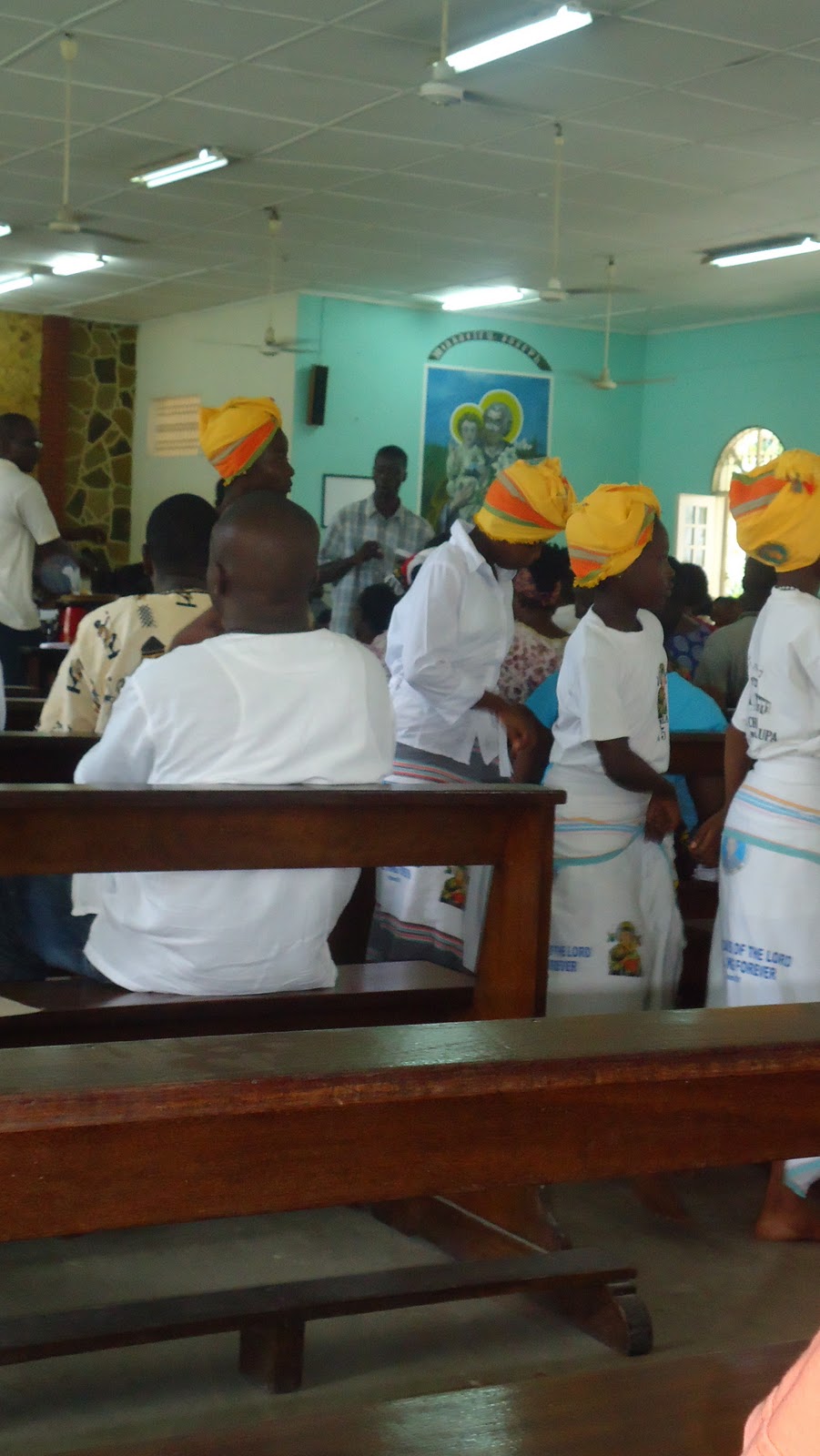
Young Taita dancers
Just when we thought the service would be ending, the priest would call up another family member to say something, or he would add another short message, or he would perform another ritual. Soooo long to sit in a cramped church on a blazing hot day.

Our view of the wedding
When the ceremony finally ended, we headed across town to the reception. We ate biryani rice, which I think is just rice cooked with spices and oil, with goat meat stew. We ate with our hands of course. The four of us shared two servings; it’s incredible how much food the serve here.

Reception grounds
Interestingly, the wedding guests ate before the wedding party had even arrived at the reception facility. When they did arrive, they entered to music and the crowd greeted them with singing and dancing, escorting them to the head table in a parade-like fashion. They were served a more elaborate meal there as the guests sat and socialized.

Welcoming the wedding party
We left before the cutting of the cake (they do it at the end so people will stick around) because we had to get back to work. We were told it was a pretty typical Kenyan wedding but that it had distinct coastal influences, both in the music and the food.

The four Mombasa-based SIT students and Yieri's host cousin, Samba

Monday, November 28, 2011

Teacher's Favorites

Friday is an intense day of prayer for the Muslim people, and the streets of Mombasa were alive with people going back and forth to the mosques. In this way, it felt a little similar to the Black Friday atmosphere at home…busy and overwhelming. I worked on my research paper most of the morning to avoid the throngs of people.

For lunch, however, I was forced to venture out into the streets. The SIT academic director, Jamal, lives in Mombasa and invited us to his house for an afternoon meal. We walked across town under the brutal sun and finally reached Jamal’s home.

Jamal with one of the twins
His wife is so welcoming and his kids are adorable. And the food…wow. The Swahili people know how to cook. We had fragrantly spiced chicken and fried fish, seasoned veggies, salad, rice, awesome naan, ripe mangoes, and fresh tamarind juice. Such an needed break from paper writing.

The girls' mat
And the boys' mat
After lunch, Jamal had to run errands, but we stuck around for a while to chat with his wife. She’s young (only 32), and they have 5 kids. She was only 18 when they were married, and we had fun hearing her opinion on early marriage (she actually advised against it; she hopes her daughters wait until after they have been educated). We think of Jamal as our professor; hearing about his culture and strong Muslim faith was fascinating. He barely knew his wife when they were married, but they seem very happy.


Friday, November 25, 2011

Turkey Day = Chicken Tikka Day?

We made it work. While at home I normally celebrate with a Thanksgiving lunch, we had a Thanksgiving dinner here in Mombasa. It was far from traditional, but I guess we worked with what we had.


Round 1
Chicken Tikka from Barka Restaurant’s sidewalk charcoal grill pit. A Middle-Eastern take on barbequed poulty.
Some of the best chicken I've ever had
Sauteed vegetables, prepared by yours truly. We purchased them today from a huge local market, where we bartered like we’ve been in Kenyan markets our whole lives.


Our haul? 3 peppers, 4 gigantic carrots, 4 zucchini, 3 beets, 2 onions, 2 heads of broccoli, and garlic….for a whopping total of around 200 shillings ($2). Not bad, I think.

And I didn’t even burn anything while attempting to cook a massive amount of vegetables on an unpredictable gas stove. There wasn’t much left over, so I’m hopinh that’s a good sign.

Fresh-baked bread, courtesy of Charlotte, our Danish roommate. Reeeeally good.

Makeshift Mini-feast
Dessert #1: Crepes. Truly American, I know. But we have Nutella, and we have two Europeans. It seemed natural.

Crepes and options: Nutella, sugar, and Kenya's "maple-flavored syrup"
And last but not least, dessert #2….a pumpkin pie! Yeah, it actually happened. Homemade. Peter, the Belgian of the European roommate couple, bravely dared to bake a pie in Kenya. There were a number of necessary adjustments because...

1. We don’t have a pie pan. Enter a frying pan with a metal handle…pumpkin pot pie.
2. True pumpkins are in season in January. Kenyans at the market pointed us to their “pumpkins” which look suspiciously like butternut squash. Vegetable cousins are bound to taste similar in a pie, right?
3. They don’t sell premade crusts here. Peter made one from scratch using a fork to mix for quite some time before reaching pie-crust consistency.

The “pumpkin” indeed turned out to be a butternut squash. Mashing it was pretty difficult. We tried soaking it, steaming it, and finally baking it before it was mash-able.

"Well, maybe if we bake it...?"
After we obtained enough mashed squash for the recipe, Peter slaved away in the kitchen after dessert round #1 while the rest of us watch “Crazy, Stupid Love”, our most recent $1 movie find.

At around 10 PM, this appeared from the kitchen. 

"Alright, it's done! Does this look like a pumpkin pie?"
The moment of truth had arrived…how would this strange Kenyan experiment taste?

Good. Darn good, actually. It was a little bit like a quiche compared to regular pumpkin pie, but the spices were on point, and the crust was the best I’ve tasted. I would actually make a butternut squash pie again.

So there it is. Our Thanksgiving celebration was a success, in my opinion. Delicious food, new friends, exciting experiences…something to be thankful for.

We go with the flow. The apartment only has 2 cups and 3 coffee mugs. 
Earlier in the day, we had lunch at our newly discovered favorite Kenyan restaurant, Barka. We kept it traditionally American—coconut-covered beans, sukuma wiki (kale), eggplant, and chapati. Maybe not so traditional, but still delicious. Arguably the best chapati and vegetables in town.

I think Coca-Cola donated all the restaurant signs in Kenya.
Buffet style, but you pick what you want. Don't judge a book by its cover; this place is incredible.

Wednesday, November 23, 2011

Traditional Thanksgiving?


Oh a holiday abroad. By the time November rolls around, I think most study abroad students are pretty homesick. All we really want is a little taste of home. I’ve had dozens of conversations with the girls I’m living with about how we can celebrate this delicious holiday in a country with unfamiliar foods and an unpredictable gas stove.

Turkey? Haven’t seen one during my time here.
Stuffing? The seasonings are the best part, but we don’t want to buy bottles for a one-time use.
Sweet potato soufflĂ©? The most heartbreaking absence, I think. They don’t have yams. Sweet potatoes are much different—more the consistency and color of regular potatoes but just a little sweeter. It wouldn’t be the same.
Pie? Too adventurous for us, and we can’t buy a crust here.

So what are four poor, hungry American girls to do? We’ve tossed around a few ideas.

A massive breakfast feast with pancakes, peanut butter, nutella, and banana?
A street-food adventure, where we buy chicken shwarma sandwiches from sidewalk carts and roasted corn from streetside charcoal pits?
A visit to one of the resorts, where they’re bound to have an expensive buffet to cater to American tourists?
A day of denial, where we eat PB'n'Js and avoid looking at calendars?

Hopefully all will be sorted out when turkey day rolls around.
Safe travels to your Thanksgiving destinations! 

Monday, November 21, 2011

Mombasaaaaa


I’ve been in Mombasa for the past week, and I feel like I really haven’t done a whole lot. The time has reminded me of being at school back in the US, where my schedule is flexible and most of my time is spent on schoolwork. Life in the villages was so different…it’s been an adjustment to live without a host family and to spend days with my peers instead of myself.
My room, shared with Grace, another SIT student
Day one in Mombasa consisted of moving into an apartment with three other SIT students. I’m amazed at how great the place is. It’s a seaside apartment on the island part of Mombasa, and it’s just down the street from the historical Fort Jesus. 
Yeah, it really is that incredible. I honestly don't know how we are able to stay here.
It has incredible balconies overlooking the water, and it’s fully furnished. We have a fridge, a microwave, and a coffee maker (thank goodness).

The kitchen. We have ant problems, but that's my only complaint.
We even have a washing machine, although we have to manually fill it for every cycle. Lugging a five-gallon bucket of water back and forth 9 times has really made me aware of just how much water I waste at home. Lessons learned in Kenya, I suppose.

We have a TV and a DVD player as well, and we can get (totally legal?) new releases on the street for $1….it has had a really positive impact on my 40-page final paper.

Hmmm..... 
There’s a European couple staying in the apartment as well. They’re only a couple years older than us, and they’re volunteering as coordinators for the AFS foreign exchange program here in Mombasa. We’re all getting along well, and it’s been interesting to compare notes on our Kenya experiences.

Sunday, November 20, 2011

Funzi: a working vacation?


Disclaimer: The formatting on this post is screwed up, but I can't figure out why or how to fix it so I'm posting anyway! 


After a week alone in Shirazi, I was ready to move on to another site to continue my research. The island of Funzi. I boarded a small boat in the nearby village of Bodo with my Funzi host mother, Mima. Mima spoke excellent English and even acted as my translator for interviews.


We arrived on the island in the early evening and dropped off my bags, the heaviest of which Mima simply positioned on her head to carry. Amazing; they do this with huge water containers, firewood, everything.

My Funzi room. Very nice, especially in comparison to Shirazi. Still no electricity, but...cement floor, iron sheets, chairs…it felt like a resort.


Well in front of my home
Mima took me to visit Grace, the other student living in Funzi. Grace’s host mother prepared us delicious chai and chatted with Mima while Grace discussed our village experiences.

Funzi food was incredible. I mean, Shirazi had fish…but where Shirazi fish are guppies, Funzi fish are more like salmon. Legitimate fillets, served with coconut rice and covered with a creamy orange coconut sauce. And breakfast? Some mandazi, of course, but everyday Mima’s sister made us big omelets full of vegetables. One day she concocted some sort of chapati/pancake hybrid, which was actually really delicious. 
Nashamba, Mima's sister and excellent chef
Mima was so kind and accommodating, and I could tell she was trying to create some American-type things to make me feel at home.


I wish I could have spent more time in Funzi; three days just wasn’t enough. Our last day on the island, Grace and I were able to swim, and in the mornings we could run on the beach. Our mothers were helicopter parents, escorting us to the bathroom…but it’s nice to have a mom away from home!

Pictures don't do it justice
Oh, and my research went well here. That's what's important, right? Funzi is home to two resorts that see a lot of traffic from European tourists. They pass through the village market on tours from time to time; I received some strange looks as a sat among the villagers wearing a muumuu, holding a notebook, and stuttering in Kiswahili. 

Friday, November 18, 2011

Don’t you need mafuta?


Mafuta: cooking fat. Probably solid lard from a goat. It’s a cooking staple in the coastal villages. When I and two other students bought beans to brings back to our host families, the shopkeeper was quick to ask us if we would need fat for cooking the chapati (tortilla-like things) to go with the beans. We assured them that, actually, the mafuta was not necessary. Our families always seem to have plenty on hand to add some nutrition to their meals.

Our first mission in Mombasa was to find some pure, unadulterated vegetables. Naturally crunchy rather than fried to crispiness.

Don’t get me wrong, I’m really not hating on chapati—it might be my favorite starch in the villages. My Shirazi Mama makes a mean chapati, even if it is soaked in goat fat. Frying is the most efficient way to cook over a fire. They make it work.

Typical breakfast: mandazi. These are made from fresh coconut milk, flour, yeast, sugar, and oil. My sister Mwanasha is a pro: roll it out, cut it into triangles, let it rise.....and fry it. Oh well. When in a village, eat like the villagers.


I was excited to be in Shirazi for the EID, the Muslim New Year. It was a day of celebration from morning to evening. Breakfast was extravagant and delicious: coconut covered beans (mbaazi) and mandazi. Not my typical eggs and toast, but I may start eating beans for brekkie regularly.


Here’s another breakfast: beans again (or rather, bowl where beans were. Yum). White bread, which mama thinks is a delicacy. And a fried fish. That day, I received a crispy little swimmer at breakfast, lunch, and dinner. Life in a coastal village.

Got used to the fish after a while--at first the head/eye/skin really creeped me out.